
Multi Niche vs Single Niche Website: Which is Better in 2026?

You go through a guide on how to make money with websites and land on affiliate marketing. The idea of niches comes up, then suddenly there’s a split between single niche and multi niche.
One says stay focused. Another says expand and cover more ground. Now it’s not as straightforward as it seemed.
That’s where the question of a multi niche vs single niche website starts to matter.
Once you understand how each approach works, it becomes easier to decide what direction actually fits what you’re trying to build.
What are Multi Niche and Single Niche Websites?
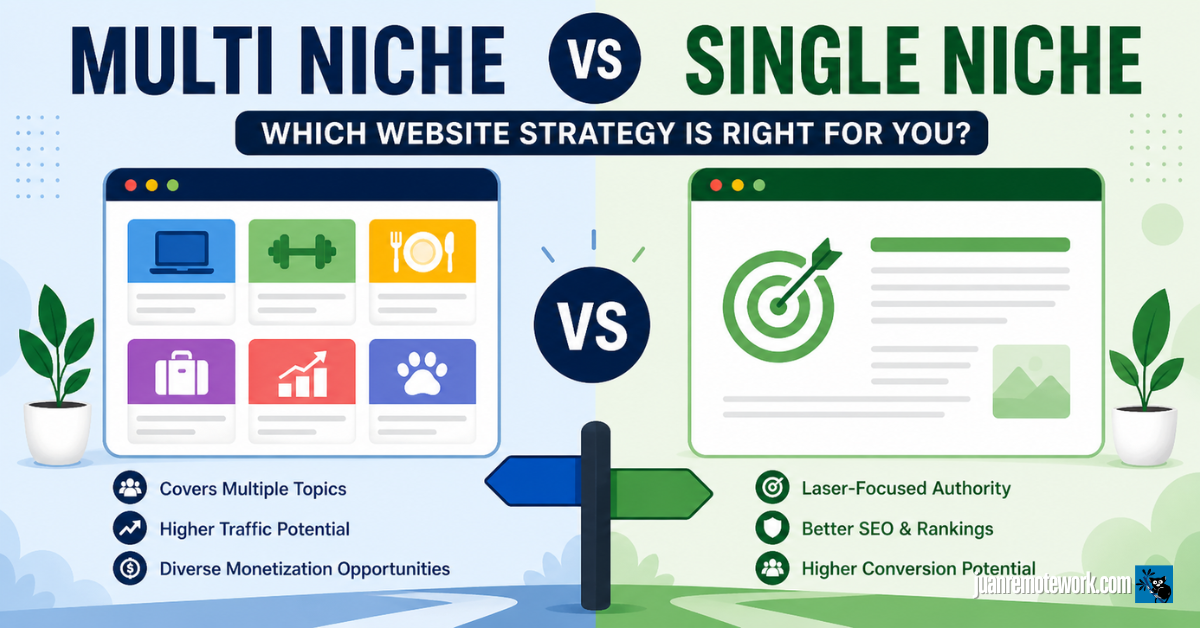
One covers a lot of topics, while the other focuses on a single topic more specifically.
Multi Niche Overview
A multi niche website basically means a website that covers multiple topics. These topics can either be unrelated or connected under a broader theme or audience.
For example, let’s say this website, JuanRemoteWork.
The niches covered on this website range from “how to become an online Filipino freelancer,” “marketing-related topics,” “adulting as an online Filipino freelancer,” and so on.
Though it may not be apparent at first glance, our website is a strong example of a multi-niche website.
Pros
- Allows you to target a wider range of topics, increasing overall traffic potential.
- Gives you flexibility to create content based on trends, interests, or opportunities.
- Opens up multiple monetization paths across different niches.
- Reduces reliance on a single niche if one underperforms.
- Lets you build a broader personal brand instead of being boxed into one topic.
Cons
- Makes it harder to build strong topical authority in the eyes of search engines.
- Can slow down SEO growth if topics are not properly structured.
- Requires clear organization to avoid a scattered or confusing site experience.
- May lead to lower conversion rates due to mixed audience intent.
- Becomes more difficult to manage and scale without a solid content system.
Single Niche Overview
A single niche website focuses on one main topic.
It expands into related subtopics.
For example, if this site only focused on becoming a Virtual Assistant, everything published would revolve around that. This includes VA questionnaires, how to get clients, tools to use, interview tips, and more.
It’s essentially one main category, broken down into smaller, more specific pieces.
Pros
- Easier to build strong topical authority in one clear area.
- Faster SEO growth because search engines understand your site more quickly.
- Higher trust and credibility with a focused audience.
- Better conversion rates due to consistent user intent.
- Simpler content planning, structure, and internal linking.
Cons
- Limits the range of topics you can create content on.
- Traffic potential depends heavily on the size of the niche.
- Can lead to content fatigue if the niche is too narrow.
- Higher risk if the niche loses demand or interest.
- Less flexibility to pivot into other topics without restructuring.
Which is Better Between a Single Niche and a Multi Niche Website?
Honestly, it depends on your goals.
If you’re looking for something fast and focused, then a single-niche website would be a better fit. It’s easier to build authority and see results earlier.
But if you’re looking for more flexibility and the ability to cover multiple related topics, then a properly structured multi-niche website would be a good choice. It gives you more room to grow and expand over time.
How to Choose Between Doing a Multi Niche and Single Niche Website
At the end of the day, this comes down to how you want to grow your site and what you’re trying to achieve.
Do a Multi Niche Website If:
You Want Flexibility
You don’t want to be boxed into one topic and prefer the freedom to explore multiple related areas over time.
You’re Building a Personal Brand
Your content revolves around you or a specific audience, not just one topic.
Your Topics Naturally Connect
Your niches share a common theme, audience, or life stage, making it easier to structure them together.
You Have a Long Term Growth Mindset
You’re willing to trade slower early results for broader reach and expansion later on.
You Can Structure Your Content Properly
You understand the importance of categories, silos, and organization to keep your site clear and focused.
Do a Single Niche Website If:
You Want Faster SEO Results
You want to rank quicker by focusing all your content on one clear topic.
You Prefer a Clear and Simple Structure
You want your site to be easy to manage, plan, and optimize without added complexity.
You’re Focused on One Main Goal
You’re targeting a specific audience or outcome, such as generating leads or building authority in one area.
You’re Working Solo or With Limited Resources
You want something manageable without needing a large content system or team.
You Want Higher Conversion Potential
You want a more focused audience, which often leads to better trust and stronger conversions.
FAQs About Single Niche and Multi Niche Websites
Which is better for SEO?
A single-niche website is generally better for SEO, especially early on, because it’s easier to build clear topical authority. That said, a properly structured multi-niche website can still perform well if the topics are related and organized into clear content clusters.
Which makes more money?
It depends on your strategy. A single-niche website often converts better due to a more focused audience, while a multi-niche website has higher traffic potential, which can lead to more monetization opportunities over time.
Which is easier to manage?
A single-niche website is easier to manage because it has a simpler structure and clearer direction. A multi-niche website requires more planning, organization, and consistency to keep everything aligned.
Which is better long-term?
A properly structured multi-niche website can be better long-term because it allows you to expand into related topics and grow your reach. However, many successful sites start as single-niche and expand over time.
Can I combine both?
Yes, and this is often the most effective approach. You can start with a single niche to build authority, then expand into related topics, creating a structured multi-niche website with clear categories and content silos.
Conclusion
Choosing between a multi niche vs single niche website isn’t about picking the “right” answer. It’s about choosing what fits how you want to build.
A single-niche website gives you focus. It helps you build authority faster, stay organized, and convert a specific audience more effectively.
A multi-niche website gives you flexibility. It allows you to explore multiple related topics, grow into different areas, and build something broader over time. If you take a look at how sites like Juan Remote Work are structured, you’ll notice how different topics can still connect under one clear direction.
If you’re still unsure, start simple. Focus on one main topic, build your foundation, and expand once things start to click. You can explore different directions through your blog and see what naturally gains traction, whether that’s something specific like SEO for lawyers or broader lifestyle-related content like the best walking pad in the Philippines.
Whichever path you take, what matters most is clarity, structure, and consistency. That’s what turns a site into something that actually grows.