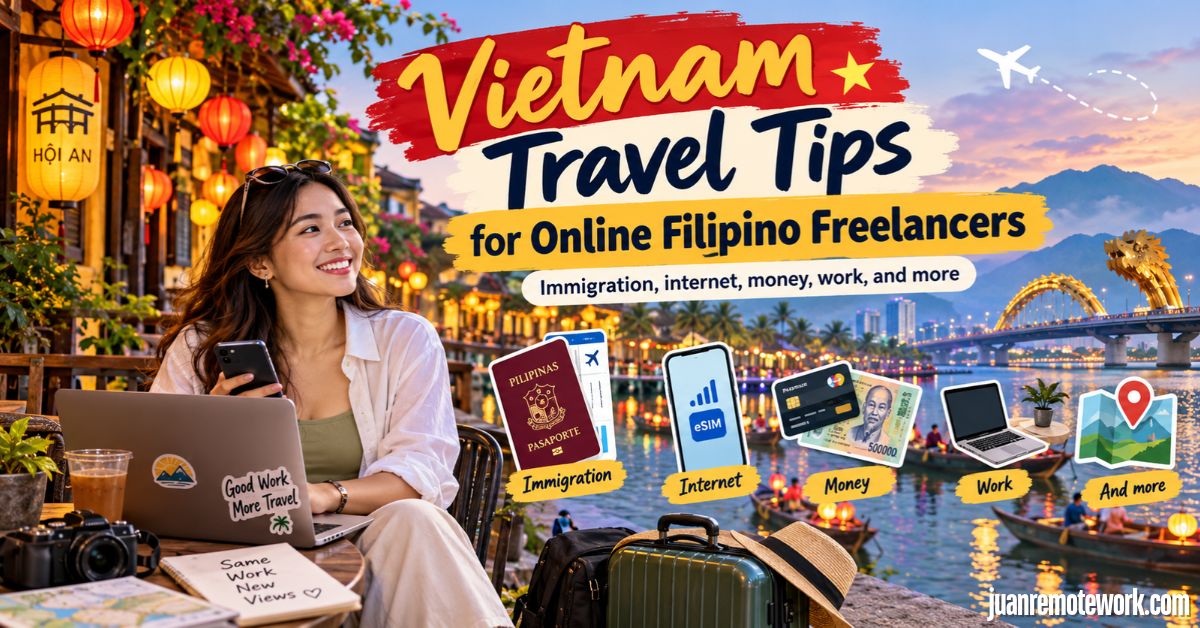
10 Best Vietnam Travel Tips for Online Filipino Freelancers

Booked na ang Vietnam trip mo, pero ngayon mo lang na-realize na… marami ka pa palang kailangang ihanda.
As an online Filipino freelancer, it’s not just your flight tickets and hotel bookings you need to think about. May immigration requirements ka pang aasikasuhin, internet connection na kailangang i-secure, at work commitments na dapat ayusin before leaving.
And then there’s the usual travel preparation: money, SIM cards, transportation, and other things you might not be familiar with yet.
So, where do you start?
We’ve put together these practical Vietnam travel tips to help you prepare, especially if it’s your first time traveling abroad as a freelancer.
Should You Be Worried About Traveling to Vietnam as a Filipino Freelancer?
Well, not really.
If you’re worried about immigration, hindi naman porket freelancer ka, mas mataas na agad ang chance mong ma-offload. What’s important is that you meet the travel requirements and can explain your purpose for visiting.
If it’s about work, that depends on your arrangement with your clients and whether you plan to work during your trip.
And if it’s simply because this is your first time visiting Vietnam, understandable naman na may kaba, especially when you’re not sure what to expect.
The good news is that most of these concerns can be addressed with proper preparation. We’ve covered the important things you need to know in the travel tips below.
What Travel Tips Should Online Filipino Freelancers Know Before Visiting Vietnam?
Here are some tips to keep in mind to help you prepare for your Vietnam trip. It’s a fairly long list, as we want to cover as much of the topic as possible!
1. Prepare Your Travel Documents and Freelance Work Requirements
If this is your first international trip as a freelancer, start by preparing your travel documents.
Unlike regular employees who can present a company ID or Certificate of Employment (COE), freelancers usually have different ways of proving their source of income.
Hindi naman ibig sabihin na kailangan mong dalhin lahat ng client contracts mo. But if Philippine immigration asks about your occupation, it’s good to have documents ready.
The good news is that Filipino ordinary passport holders can visit Vietnam visa-free for up to 21 days, making it convenient for short vacations.
Still, you should prepare the usual travel requirements:
- Valid Philippine passport: Make sure it has at least six months of remaining validity.
- Return or onward flight ticket: Proof that you’ll leave Vietnam after your visit.
- Hotel booking: A confirmed reservation showing where you’ll stay.
- Travel itinerary: A simple schedule of your planned destinations and activities.
- Proof of funds: Bank statements or other documents showing you can afford the trip.
- Freelance work documents: Client contracts, invoices, or certificates of engagement, in case immigration asks about your work.
You don’t need to print everything. Save digital copies on your phone and make sure accessible pa rin sila kahit walang internet.
However, I would still recommend printing essential documents like your flight confirmation and hotel reservation.
Don’t forget your eTravel registration.
Before leaving and returning to the Philippines, register through the official eTravel website within 72 hours of the relevant departure or arrival.
It’s free, so there’s no need to pay third-party websites. Save a screenshot of your QR code once you’re done.
One more thing: visa-free entry doesn’t automatically mean you’re allowed to work in Vietnam.
If you plan to perform paid remote work during your visit, check Vietnam’s immigration and work authorization rules first.
For a short vacation, mas practical kung tapos mo na ang major client deliverables before your trip so you can focus on enjoying your stay.
2. Get a Reliable Internet Connection Before Traveling to Vietnam
As an online freelancer, your internet connection is probably one of the last things you’d want to worry about while traveling.
Even if you’re taking a vacation, you might still need mobile data to check messages, access your banking apps, or contact your accommodation.
Kaya mas okay kung may sarili kang internet connection instead of relying entirely on public Wi-Fi.
Buy a Vietnam SIM card or eSIM.
You can purchase a prepaid SIM from local telecommunications providers like Viettel, Vinaphone, or MobiFone.
Another option is buying a travel eSIM before leaving the Philippines.
May mga available na travel SIMs and eSIM packages on Shopee, Klook, and other online providers.
Before buying, check the following:
- Data allocation: How many GB you’ll receive or whether the package offers unlimited data.
- Validity: How many days the SIM or eSIM remains active.
- Network provider: Which Vietnamese network you’ll be using.
- Hotspot support: Whether you can share your connection with your laptop.
- Phone compatibility: Whether your device supports the SIM or eSIM.
- Activation: When your package starts counting its validity period.
For example, if you’re only visiting Vietnam for four days, you probably don’t need an expensive 30-day data package.
Unless, of course, mas sulit talaga yung longer package.
Just remember that cheaper doesn’t always mean better. Check reviews about coverage and connection reliability before purchasing.
Don’t rely entirely on hotel Wi-Fi.
Most hotels in Vietnam advertise free Wi-Fi, but that doesn’t necessarily mean the connection is fast or stable.
Some accommodations may have decent internet for browsing but struggle with video calls or large file uploads.
Before booking, check recent guest reviews and look for comments about Wi-Fi quality.
If you’ll be working during your stay, you can also message the hotel and request a recent internet speed test.
Ideally, use hotel Wi-Fi as your primary connection and mobile data as your backup.
Para kung biglang bumagal or mawalan ng internet sa hotel, may alternative ka.
3. Secure Your Work Accounts, Files, and Devices Before Departure
For many online freelancers, their laptop is also their livelihood.
Kaya kung dadalhin mo ang laptop mo sa Vietnam, don’t just focus on keeping it physically safe. Make sure your work files and accounts are protected, too.
Start by backing up your important documents.
If you use Google Drive, Dropbox, Notion, or other cloud-based platforms, check whether your files have finished syncing before departure.
For documents you might need during the trip, consider saving offline copies.
That way, you can still access them kahit mawalan ka ng internet.
Check your account security settings, too.
Some websites and applications may detect that you’re signing in from another country and ask for additional verification.
This is particularly common with banking applications, email accounts, and other platforms that handle sensitive information.
Before leaving, make sure to:
- Check that your authenticator apps are working.
- Save your backup recovery codes somewhere secure.
- Confirm that your Philippine SIM can still receive verification messages abroad.
- Enable passwords, biometrics, or screen locks on your devices.
- Update your laptop and phone’s operating systems.
- Review your client’s policies regarding international account access.
If your work involves sensitive client data, avoid using unsecured public Wi-Fi. Stick to trusted connections and follow your client’s security requirements.
Don’t forget about physical security.
If you’re heading out for sightseeing, make sure your laptop is stored securely at your accommodation.
And if you’re visiting during Vietnam’s rainy season, bring a waterproof laptop sleeve or protective bag.
Sayang naman kung masira ang laptop mo dahil lang nabasa habang naglalakad.
4. Prepare Vietnamese Dong and Other Payment Methods
Vietnam uses the Vietnamese dong (VND), and one thing you’ll probably notice is how large the currency denominations are.
You’ll regularly encounter prices in tens or hundreds of thousands of dong.
Medyo nakakalito sa umpisa, especially if you’re used to calculating everything in Philippine pesos.
Before your trip, familiarize yourself with the exchange rate and common Vietnamese banknotes.
But don’t worry. You don’t necessarily need to convert your entire travel budget into Vietnamese dong before leaving the Philippines.
Many hotels, restaurants, and larger establishments accept international debit and credit cards.
However, cash is still useful for street food, local markets, and smaller businesses.
Ideally, prepare at least two payment methods.
GCash Card
If you already have a GCash Card, you may be able to use it for purchases and ATM withdrawals in Vietnam, provided the establishment or ATM supports your card’s payment network.
GCash currently advertises 0% foreign exchange fees on international card purchases. However, ATM operators may still charge separate withdrawal fees.
Before your trip, make sure your card is activated and your account is fully verified.
Also, don’t assume na lahat ng Vietnamese stores na may QR payments ay tumatanggap ng GCash QR.
Wise Card
If you’re already using Wise for your freelance payments, you might also consider its card.
Depending on your account eligibility and supported features, Wise can be useful for managing international payments and making purchases abroad.
However, compare its fees with your existing cards first.
Kung three or four days ka lang naman sa Vietnam at may GCash Card and credit card ka na, you might not need another one.
Credit Card
Credit cards are useful for hotel payments, larger purchases, and emergencies.
Just check your bank’s foreign transaction fees and make sure international transactions are enabled before departure.
If a payment terminal asks whether you’d like to pay in Philippine pesos or Vietnamese dong, choosing VND is generally preferable to avoid unfavorable currency conversion rates.
Cash
Even if you prefer cashless transactions, bring some Vietnamese dong.
You’ll likely need it for smaller purchases, local food stalls, or establishments that don’t accept cards.
You can withdraw VND from reputable ATMs after arriving or exchange money through legitimate currency exchange providers.
And one practical tip: huwag mong ilagay lahat ng pera at cards mo sa iisang wallet.
Keep a backup card and some emergency cash somewhere separate.
That way, if you lose your wallet or your primary card stops working, hindi ka agad maiipit.
5. Buy Essential Travel Accessories for Your Trip
Aside from your clothes and toiletries, there are a few travel accessories worth bringing to Vietnam.
Hindi naman kailangan bumili ng kung anu-ano. Focus on items that will actually make your trip easier, especially if you’re bringing a laptop or other work equipment.
Here are some worth considering:
| Travel accessory | Why bring it? |
|---|---|
| Universal travel adapter | Para compatible ang chargers mo sa electrical outlets |
| Power bank | Keep your phone charged while exploring |
| Waterproof laptop sleeve | Protect your laptop from rain and moisture |
| Compact umbrella or raincoat | Useful during Vietnam’s rainy season |
| Small backpack or daypack | Carry your everyday essentials |
| Cable organizer | Keep chargers and cables organized |
| Reusable water bottle | Stay hydrated while walking around |
| Portable laptop stand | Useful if you expect to work for several hours |
| Luggage tracker | Optional protection against misplaced luggage |
Check your chargers and electrical outlets before leaving.
Vietnam generally uses 220V electricity at 50Hz. Depending on your accommodation, you may encounter different electrical outlets, with Type C plugs being common.
Fortunately, most modern laptop and smartphone chargers support 100–240V.
So in many cases, plug adapter lang ang kailangan mo instead of a voltage converter.
Still, check your charger’s specifications to be sure.
If you’re bringing a power bank, remember that airlines generally require spare lithium batteries and power banks to be placed in cabin baggage, not checked luggage.
Check your airline’s rules regarding power bank capacity and usage.
Be mindful of your baggage allowance, too.
If you’re flying with a budget airline, your laptop, chargers, power bank, and other electronics can quickly add weight to your carry-on.
For a short three- or four-day vacation, try to pack light.
You can bring your laptop if necessary, pero hindi mo naman kailangang dalhin ang buong work setup mo.
6. Download Transportation, Navigation, and Translation Apps
If this is your first time visiting Vietnam, getting around might feel unfamiliar at first.
Hindi mo pa kabisado ang lugar, and you might encounter drivers or vendors who don’t speak much English.
Fortunately, there are several apps that can make traveling around Vietnam easier.
Grab
Good news if you’re already using Grab in the Philippines: you can also use it in major Vietnamese cities like Da Nang.
The booking process is similar.
Enter your destination, check the estimated fare, and confirm your ride.
This is particularly convenient when arriving at the airport because you won’t have to negotiate taxi fares manually.
Just make sure your payment method works and the driver’s license plate matches the booking details.
Google Maps
Google Maps is useful for finding your accommodation, restaurants, tourist attractions, and other nearby establishments.
Before leaving the Philippines, download offline maps of the places you’re planning to visit.
Para kahit mawalan ka ng mobile data, you can still access basic navigation information.
You can also save your hotel, airport, and planned destinations in advance.
Google Translate
Not everyone in Vietnam speaks English, especially at smaller local establishments.
Google Translate can help with understanding menus, signs, and basic conversations.
Its camera translation feature is particularly useful when reading Vietnamese text.
Download the Vietnamese language pack before departure so you can use supported offline features.
Zalo
Zalo is a popular messaging app in Vietnam.
You probably won’t need it for every trip, but some local businesses, accommodation providers, and guides use it to communicate with customers.
If someone you’re coordinating with prefers Zalo, it’s worth having the app available.
You don’t have to download everything, though.
Start with the apps you’ll actually use.
One more tip: save your hotel’s name and address in Vietnamese.
Mas madaling ipakita sa driver or local resident kung kailangan mong magtanong ng directions.
7. Research Vietnam’s Food, Culture, and Local Customs
Of course, you’re not traveling to Vietnam just to stay in your hotel.
One of the best parts of visiting another country is experiencing its food, culture, and everyday life.
And when it comes to food, marami kang pwedeng subukan sa Vietnam.
Vietnamese cuisine commonly uses fresh herbs, vegetables, rice noodles, and flavorful broths.
Some dishes worth trying include:
- Pho: Vietnamese noodle soup, commonly served with beef or chicken.
- Banh mi: A baguette sandwich filled with meat, vegetables, and sauces.
- Goi cuon: Fresh spring rolls served with dipping sauce.
- Bun cha: Grilled pork served with rice noodles.
- Cao lau: A noodle dish associated with Hoi An.
- Banh xeo: A crispy Vietnamese savory pancake.
If you’re a coffee lover, Vietnam’s coffee culture is also worth exploring.
You’ll find plenty of cafés serving Vietnamese coffee, including ca phe sua da, which is iced coffee with condensed milk.
Kung mahilig kang magtrabaho sa coffee shops dito sa Pilipinas, you might enjoy visiting some of Vietnam’s cafés.
Just remember that Vietnamese coffee can be quite strong, so be mindful of your caffeine intake.
Familiarize yourself with local customs, too.
For example, dress appropriately when visiting temples or religious sites.
If you want to take close-up photos of local residents, ask permission first.
At local markets, bargaining may be common, but it isn’t appropriate everywhere.
Also, prepare yourself for Vietnam’s traffic.
Motorcycles are everywhere, and crossing busy roads can feel intimidating if you’re not used to it.
Use pedestrian crossings where available, watch approaching vehicles carefully, and avoid sudden movements.
Lastly, try learning a few Vietnamese phrases before your trip.
Hindi mo naman kailangang maging fluent. Even knowing how to greet someone or say thank you can make a difference.
8. Check the Weather Conditions Before Planning Your Activities
Vietnam’s weather varies depending on where you’re visiting.
For example, the weather in Hanoi can be very different from what’s happening in Ho Chi Minh City, Da Nang, or Hoi An.
Kaya before finalizing your itinerary, check the weather conditions of your specific destination.
If you’re visiting Da Nang or Hoi An, pay particular attention to the rainy season.
Da Nang generally experiences its rainy season from September to February, while Hoi An can experience heavy rainfall and flooding around October and November.
Hindi naman ibig sabihin na bawal ka nang bumisita during these months.
You can still enjoy your vacation, but you’ll need to be more flexible with your plans.
For example, outdoor tours may be canceled because of heavy rain, while some roads and attractions might become temporarily inaccessible due to flooding.
Before your trip:
- Check the weather forecast regularly.
- Monitor official weather advisories.
- Bring a raincoat, umbrella, and waterproof protection for electronics.
- Research whether your accommodation is located in a flood-prone area.
- Avoid booking too many nonrefundable outdoor activities.
- Prepare alternative indoor attractions.
If you’re visiting for only three or four days, avoid filling your schedule with too many activities.
Mas okay na may allowance ka to adjust your plans if the weather suddenly changes.
This matters even more if you’re bringing work with you.
Heavy rain or flooding could affect electricity, transportation, and internet connectivity.
If you have an important client meeting, avoid scheduling it around an outdoor activity or a long trip between destinations.
And if there’s a serious weather warning, prioritize your safety.
Hindi worth it ipilit ang itinerary kung delikado naman ang conditions.
9. Set a Realistic Travel Budget and Prepare Emergency Funds
Vietnam is often considered an affordable destination for Filipino travelers.
But that doesn’t mean everything will automatically be cheap.
Your expenses will still depend on your accommodation, food choices, transportation, and planned activities.
For example, staying at a budget hotel and eating at local restaurants will usually cost less than booking a luxury resort and dining at tourist-oriented establishments.
Before leaving, prepare a budget for:
- Round-trip flights and baggage fees.
- Hotel or accommodation.
- Daily meals, snacks, and coffee.
- Transportation.
- SIM card or eSIM.
- Tourist attractions and activities.
- Travel insurance.
- Shopping and miscellaneous expenses.
If you’re traveling with your partner or friends, decide which expenses you’ll share.
For example, you can split hotel and transportation costs while keeping separate budgets for shopping and personal purchases.
Prepare emergency funds, too.
Ideally, hiwalay ang emergency budget mo sa perang nakalaan for your vacation.
You might need extra money if your flight gets delayed, you need another night at your hotel, or an unexpected medical expense comes up.
Also, don’t rely entirely on upcoming freelance payments.
Alam naman natin na minsan delayed ang payments ng clients. Banking transactions can also take longer than expected, especially when international transfers are involved.
So if possible, make sure your travel expenses are already covered before departure.
Lastly, track your spending.
Vietnamese dong has large denominations, so it’s easy to lose track of how much you’re spending in Philippine pesos.
Using a currency converter or a simple expense tracker can help.
Para hindi ka magugulat pag-check mo ng total expenses after your trip.
10. Plan Your Itinerary Around Your Freelance Work Schedule
One of the advantages of freelancing is having more flexibility over your schedule.
But as we all know, being a freelancer doesn’t automatically mean you can disappear from work whenever you want.
You might still have client deadlines, scheduled meetings, or ongoing projects that need your attention.
Kaya before finalizing your itinerary, check your work calendar first.
Finish important deliverables before departure.
If you have articles, reports, designs, or other assignments due around your travel dates, try completing them ahead of schedule.
That way, hindi mo na kailangang maghabol ng deadlines habang nasa Vietnam ka.
Inform your clients about your availability.
You don’t have to share your entire vacation itinerary with them.
A simple message explaining your travel dates and expected availability should be enough.
If you’re taking a complete break, let them know.
If you’ll only be available for urgent matters, communicate that clearly.
Remember Vietnam’s time zone.
Vietnam is one hour behind the Philippines.
For example, if your meeting is scheduled at 9 AM Philippine time, that would be 8 AM in Vietnam.
If you’re working with US-based clients, double-check their time zones as well, especially when daylight saving time applies.
Avoid overloading your travel schedule.
It’s tempting to visit as many attractions as possible, especially when you’re only staying for a few days.
But imagine spending the whole day sightseeing, getting back to your hotel exhausted, and remembering that you still have several hours of work waiting for you.
Medyo sayang naman ang vacation kung ganun.
If you’re legally permitted to perform remote work during your visit and genuinely need to handle a few tasks, set realistic work hours.
Otherwise, the better option for a short vacation is to complete your assignments beforehand and take a proper break.
There’s nothing wrong with bringing your laptop for emergencies, but you don’t have to use it every day.
After all, pinaghirapan mo rin ang perang ginastos mo para sa trip na ‘to.
Make time to explore Vietnam, try its food, enjoy the local culture, and experience something different from your usual routine.
Most of these preparations can be done before leaving the Philippines, so there’s no need to rush through everything at the last minute.
Once your travel documents, money, internet connection, and work commitments are sorted out, mas makakapag-focus ka na sa actual vacation.
And hopefully, you’ll spend more time enjoying Vietnam than worrying about your next client deadline.
FAQs About Vietnam Travel Tips for Online Filipino Freelancers
Can I show my freelance client contracts instead of a Certificate of Employment at immigration?
Yes, you can present client contracts, invoices, or certificates of engagement as supporting proof of your freelance work if immigration asks. However, these aren’t guaranteed substitutes for every document an officer might request. Mas okay kung may additional proof of income ka rin, such as bank statements or business registration documents, if applicable.
Should I buy a Vietnam SIM card in the Philippines or after arriving in Vietnam?
Both options are fine. Buying a travel SIM or eSIM before departure through platforms like Shopee or Klook means you can have internet access as soon as you arrive. Purchasing a local SIM in Vietnam may give you more choices, but you’ll need to find a legitimate seller and complete any required registration. Kung eSIM ang pipiliin mo, check your phone’s compatibility first.
Will I still receive GCash and banking OTPs in Vietnam?
Yes, you can generally receive OTPs on your Philippine number abroad if your mobile provider supports roaming and your SIM remains active. However, hindi guaranteed na lahat ng OTP ay darating, especially if there are roaming or network issues. Enable the necessary roaming services before departure, and prepare backup authentication methods.
Do I need a VPN when accessing my freelance work accounts in Vietnam?
Not necessarily. Most common work platforms can be accessed without a VPN, but you may need one if your client requires an approved secure connection. Don’t assume a VPN automatically makes public Wi-Fi safe. Kung may company security policy, follow that first before accessing sensitive work files abroad.
Can I use my GCash Card to withdraw Vietnamese dong from ATMs?
Yes, provided your GCash Card is active and the ATM accepts its payment network. The withdrawal will be dispensed in Vietnamese dong, with applicable conversion and ATM fees. Before traveling, check your card’s withdrawal limits and current charges para hindi ka mabigla sa deductions.
Should I exchange Philippine pesos for Vietnamese dong before leaving?
You don’t necessarily have to exchange all your money before departure. You can withdraw Vietnamese dong from supported ATMs or use legitimate currency exchange services after arriving. Mas practical na may accessible funds ka upon arrival, plus a separate backup card in case your primary payment method doesn’t work.
Is it worth buying a Wise Card for Vietnam, or are GCash and a credit card enough?
For a short Vietnam trip, your GCash Card and credit card should be enough, provided they’re enabled for international use. Kung hindi ka naman frequent traveler, there’s probably no need to get a Wise Card just for this trip.
Can I bring my laptop and power bank in my carry-on luggage?
Generally, yes. Laptops are commonly allowed in carry-on baggage, while power banks and spare lithium batteries must generally be carried in the cabin rather than checked luggage. However, airlines have specific restrictions on battery capacity and usage. Check your airline’s latest baggage policy before packing.
Can I use my Philippine phone and laptop chargers in Vietnam?
Usually, yes. Vietnam generally uses 220V electricity, which is similar to the Philippines. Most modern phone and laptop chargers support 100–240V, so a plug adapter may be all you need. Check the charger’s input label first, dahil hindi lahat ng electrical devices ay compatible.
Can I use my Philippine Grab account in Vietnam?
Generally, yes. You can use your existing Grab account in supported Vietnamese cities, although available services and payment options may differ from those in the Philippines. Before your trip, update the app and check your payment settings. Mas convenient din kung may mobile data ka agad upon arrival.
What should I do if it rains throughout my Vietnam trip?
Check which attractions remain accessible and prioritize indoor activities such as museums, restaurants, and cafés when conditions are safe. Avoid flooded streets and follow local weather advisories. Kung may booked tours ka, contact the provider about rescheduling or refunds instead of forcing your original itinerary.
How much emergency money should I prepare for Vietnam?
There’s no fixed amount, but consider setting aside enough to cover an extra hotel night, meals, transportation, and unexpected expenses. For a short trip, an additional ₱5,000–₱10,000 per person can serve as a starting planning allowance, depending on your budget. Keep some of it accessible through a separate account or card.
Should I tell my clients that I’m traveling to Vietnam?
If your trip affects your availability, deadlines, or response times, yes. You don’t have to share every detail of your vacation, but your clients should know when you’ll be unavailable. For projects involving sensitive data or location restrictions, check whether your client also requires prior approval for international access.
Should I bring my laptop if I’m only visiting Vietnam for three or four days?
If you’ve already completed your deliverables and arranged time off, you probably don’t need to bring it. However, if you’re responsible for urgent client concerns, bringing a laptop may be useful, provided you follow the applicable rules on remote work while abroad. Kung kaya namang mag-unplug for a few days, enjoy the vacation without your work equipment.
Conclusion
We hope these tips help you prepare for your Vietnam trip and make the most of your vacation. From sorting out your travel documents to managing your freelance commitments, mas okay talaga kung prepared ka before leaving.
And if you’re planning to explore other opportunities as an online freelancer, we’ve also covered the difference between single-niche and multi-niche websites if you’re interested in building your own website.
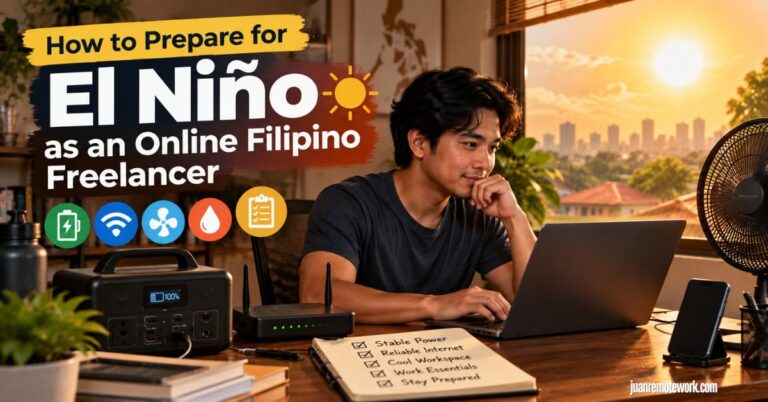
For those returning to their usual work-from-home setup after the trip, you can also check out our guide on preparing for El Niño as an online Filipino freelancer, especially when it comes to managing heat, brownouts, and internet disruptions.
We have more practical guides on our blog, and you can visit our homepage to explore what else we’ve covered for Filipino freelancers.
For now, good luck with your Vietnam preparations! Sana maging smooth ang trip ninyo, and don’t forget to enjoy the vacation you’ve worked hard for.