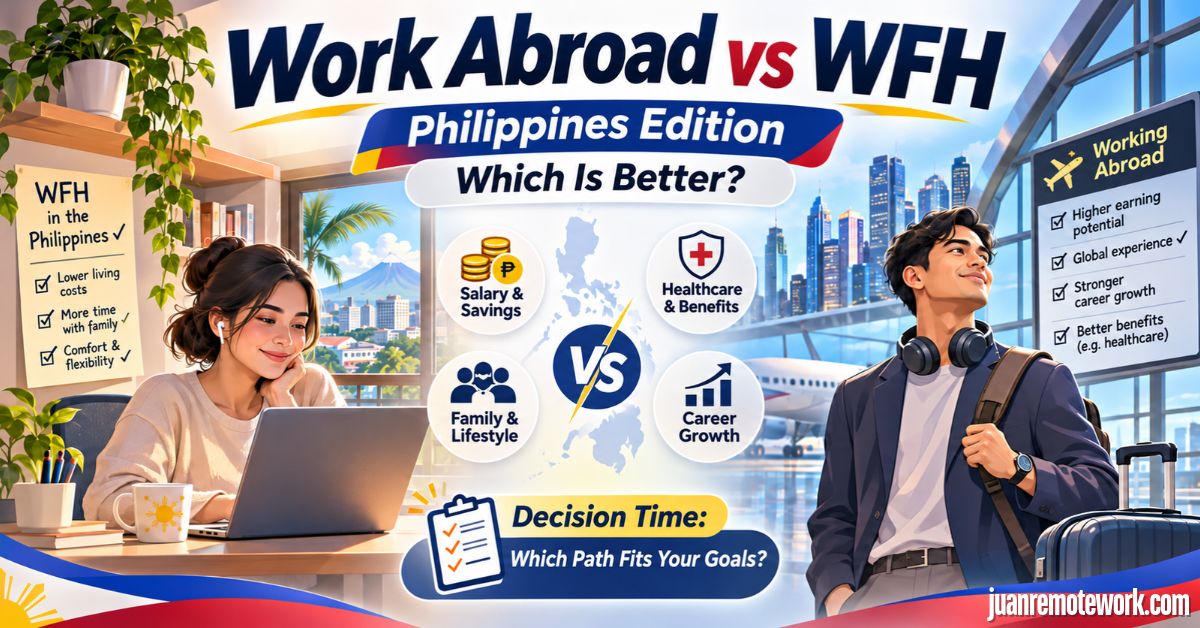
Work Abroad vs WFH [Philippines Edition] Which is Better in 2026?

With rising living costs, concerns over salaries, and ongoing issues in the Philippines, more young Filipinos are considering opportunities abroad.
In fact, a 2026 OCTA Research survey found that 81% of Filipinos aged 18–24 were open to living or working overseas, mainly for better jobs, higher salaries, and improved quality of life.
But working abroad isn’t the only option. With remote work, Filipinos can also pursue international job opportunities while staying in the Philippines.
So, is it better to work abroad or work from home in the Philippines?
In this guide, we’ll compare salaries, living expenses, savings potential, career opportunities, and quality of life to help you decide which option makes more sense for you.
Key Takeaways: Work Abroad vs. WFH in the Philippines
Why Filipinos Consider Both Options
Working abroad offers access to international jobs, potentially higher salaries, and opportunities to settle overseas. WFH allows Filipinos to pursue better-paying remote work while staying close to family.
Higher Salary Doesn’t Always Mean More Savings
Overseas jobs may pay more but often come with higher living expenses. Remote workers can benefit from lower costs in the Philippines, although job security and benefits depend on their employment arrangements.
Choose Based on Your Long-Term Goals
Compare your take-home pay, actual savings, career opportunities, and family priorities. Working abroad may make sense for migration goals, while WFH can be attractive if you’re already earning comfortably.
Compare your income, living expenses, and potential savings with our free Work Abroad vs. WFH Philippines Calculator.
Why Filipinos Are Choosing Between Working Abroad and WFH
With the rising cost of living and limited salary growth, many Filipinos are looking for better-paying opportunities.
According to Jobstreet’s 2026 Salary Pulse Report, 45% of Filipino workers said their earnings weren’t enough to cover their living expenses.
For some, working abroad is the answer. A 2026 OCTA Research survey found that 81% of Filipinos aged 18–24 were open to living or working overseas, mainly for better jobs, higher salaries, and improved quality of life.
Others are considering remote work, which allows them to earn from international employers without leaving the Philippines. A Jobstreet and BCG study based on a 2023 survey found that 84% of Filipino respondents were willing to work remotely for foreign employers.
Both options have their advantages. But which one actually makes more sense financially and offers a better quality of life?
Working Abroad vs. Working From Home in the Philippines Overview
For Filipinos looking to earn more, working abroad and working from home are two of the most attractive options. Both offer opportunities beyond traditional local employment, but they come with different experiences and trade-offs.
Working Abroad
Working abroad has been part of Filipino culture for generations. Since overseas employment expanded in the 1970s, millions of Filipinos have left the country to find better-paying jobs and support their families back home.
It’s a familiar story. Parents leave their children behind, couples live apart for years, and young professionals move overseas hoping to build a better future.
Countries such as Japan, Singapore, Australia, Canada, and the UAE remain attractive destinations for Filipinos looking for higher salaries and career opportunities.
Beyond the money, working abroad can also mean access to better public services, new experiences, and the possibility of bringing family members overseas permanently.
Working From Home in the Philippines
Working from home offers another way to pursue better-paying opportunities without leaving the country.
While online freelancing existed long before COVID-19, the pandemic helped bring remote work into the mainstream. According to the Philippine Statistics Authority, 27% of establishments with at least 20 workers adopted WFH arrangements between July 2021 and June 2022.
Online freelancing also gained traction during this period as more Filipinos explored opportunities beyond traditional office jobs.
Today, Filipinos can work with international clients in fields such as IT, marketing, customer service, and virtual assistance.
The appeal is simple: the opportunity to earn competitive international salaries while staying in the Philippines, where living expenses can be considerably lower than abroad.
There’s also the benefit of staying close to family and avoiding the costs of relocating overseas.
However, WFH isn’t without challenges. Freelancers may face unstable income, limited employment benefits, and night shifts when working with clients in different time zones.
How Does Working Abroad Compare to WFH in the Philippines?
Working abroad and WFH in the Philippines both offer opportunities to earn more. But choosing between them isn’t just about the salary.
You’ll also need to consider how much you can save, the stability of your income, and what each option means for your future.
Salary, Cost of Living, and Savings Potential
Higher salaries are one of the biggest reasons Filipinos choose to work abroad.
According to a 2026 Boston Consulting Group (BCG) study, 76% of surveyed OFWs considered expected salary a top factor when choosing a country, while 63% considered the cost of living.
This makes sense. Earning ₱180,000 abroad sounds better than earning ₱100,000 working remotely in the Philippines. But what happens once you account for taxes and living expenses?
Here’s a hypothetical monthly comparison:
| Expenses | WFH Philippines | Working Abroad |
|---|---|---|
| Take-home salary | ₱100,000 | ₱180,000 |
| Housing | ₱12,000 | ₱55,000 |
| Food and groceries | ₱10,000 | ₱25,000 |
| Transportation | ₱2,000 | ₱12,000 |
| Utilities and internet | ₱5,000 | ₱8,000 |
| Healthcare and insurance | ₱3,000 | ₱8,000 |
| Other expenses | ₱8,000 | ₱17,000 |
| Monthly savings | ₱60,000 | ₱55,000 |
| Annual savings | ₱720,000 | ₱660,000 |
These are illustrative figures, not actual salary averages or country-specific living costs. Both salaries are already after taxes and payroll deductions. Relocation costs are excluded.
Despite earning ₱80,000 more, the overseas worker saves ₱5,000 less each month.
This is why some Filipinos prefer earning in foreign currencies while spending in pesos, especially when they already have affordable housing in the Philippines.
However, the outcome could easily change if the overseas employer provides free accommodation, transportation, or other allowances.
Your actual savings matter more than the salary advertised in a job offer.
Job Security, Healthcare, and Employment Benefits
A six-figure WFH salary sounds attractive, but what happens if your client suddenly ends your contract?
This is a common concern among Filipino freelancers.
A 2026 University of the Philippines study found gaps in employment benefits and social protection among platform workers, although the research also included delivery drivers and other non-remote workers.
Unlike regular employees, independent contractors often need to arrange their own health insurance, retirement contributions, and paid time off.
In a Reddit discussion about working abroad versus freelancing, one Filipino shared that they pursued nursing opportunities in Europe despite earning six figures as a VA. Their reasons included healthcare, employment stability, and long-term security.
However, working abroad isn’t automatically more secure. Some employment contracts are temporary, and losing your job could also affect your visa status.
It’s also important to distinguish freelancers from regular remote employees, who may receive stable salaries and company benefits.
Before accepting either opportunity, compare the full compensation package, including healthcare, paid leave, insurance, and retirement contributions.
Career Opportunities and Professional Growth
Your profession can also influence which path makes more sense.
For nurses, engineers, and other professionals whose work requires physical presence, moving abroad may provide access to better-paying positions and international career opportunities.
Meanwhile, Filipinos in IT, digital marketing, design, and other digital professions can build international careers without necessarily relocating.
Interestingly, one Filipino IT professional in a Reddit discussion about overseas careers shared that working remotely for an international company eventually helped them secure a transfer to its overseas headquarters.
This shows that WFH can sometimes become a stepping stone toward working abroad.
However, both paths have limitations. Some remote workers struggle to advance beyond contractor roles, while professionals moving abroad may need additional qualifications or licenses before practicing their profession.
It’s worth considering what each job could lead to in five or ten years, not just how much it pays today.
Family, Work-Life Balance, and Quality of Life
For many Filipinos, leaving family behind is one of the hardest parts of working abroad.
While overseas employment can improve a family’s finances, it may also mean spending years away from children, partners, or aging parents.
WFH offers the opportunity to stay close to loved ones while earning an income. You can avoid daily commutes and potentially spend more time at home.
However, remote work isn’t always flexible. Night shifts, demanding clients, and irregular schedules can still affect your personal life.
Working abroad also has its lifestyle advantages, depending on the country. Better public transportation, accessible public services, and a different living environment can make relocating attractive.
In a Reddit discussion about exchanging freelance life for working abroad, one commenter explained that staying close to friends, family, and their community became more important as they grew older.
Other commenters preferred living overseas because of the public services and opportunities available there.
Neither experience is universal. What matters is the lifestyle you want and the sacrifices you’re willing to make.
Long-Term Financial Security and Migration Plans
One important difference between WFH and working abroad is what each option can offer in the long run.
For Filipinos planning to settle overseas, working abroad may provide a pathway toward permanent residency or citizenship, depending on the country and visa.
These opportunities can be particularly attractive for those planning to raise children overseas or eventually retire there.
However, migration doesn’t always guarantee a better future.
In a Reddit discussion about working abroad versus staying in the Philippines, a Filipino IT professional who moved to Canada described the challenges of competing in the overseas job market and adjusting to the country’s healthcare system.
Meanwhile, staying in the Philippines can also provide long-term financial opportunities, especially if you earn a competitive remote salary and consistently build your savings.
The key difference is your goal.
If you want to build wealth while staying close to family, a stable WFH career may be enough. If you want to settle permanently overseas, the opportunities available through migration may justify the additional expenses and challenges.
Does Your Current Income Make Working Abroad Worth It?
Your current salary can help put the decision into perspective.
For example, someone earning ₱25,000 monthly in the Philippines may have a stronger financial incentive to pursue an overseas job than someone already earning ₱120,000 remotely.
However, these figures alone don’t determine which option is better.
Someone earning ₱80,000 while living with family in the province may save more than another person earning the same amount while renting in Metro Manila.
Similarly, an overseas job providing accommodation and other benefits may be financially attractive even if its salary isn’t particularly high.
Before making a decision, compare your actual take-home pay, monthly expenses, and potential savings. Then consider whether the opportunity supports your long-term career and personal goals.
How to Decide Whether to Work Abroad or Stay in the Philippines
By now, you probably have a better idea of what working abroad and WFH can offer. But knowing their advantages is one thing. Deciding which is right for you is another.
Your current salary, family responsibilities, career goals, and financial situation should all play a part in your decision.
Here are some situations where one option may make more sense than the other.
Work Abroad If:
You Have a Job Offer That Significantly Improves Your Finances
If an overseas employer offers a salary that allows you to save considerably more after living expenses, relocating may be worth it.
However, don’t compare salaries alone. Consider taxes, accommodation, transportation, and how much you’ll need to send home.
A higher salary means little if most of it goes toward maintaining your life abroad.
Your Profession Has Better Opportunities Overseas
Some professions offer more opportunities abroad, particularly healthcare, engineering, and other specialized fields.
If your skills are in demand overseas and the position provides better career progression, international experience could help you achieve your long-term goals.
Just make sure you understand the licensing requirements and whether your qualifications will be recognized.
You Want to Migrate Permanently
If your goal is to eventually become a permanent resident or citizen of another country, working abroad could be a practical first step.
This is especially relevant if you’re planning to raise a family overseas or want access to another country’s education and public services.
However, not every work visa offers a pathway to permanent residency, so research your options before accepting an offer.
You’re Financially and Personally Prepared to Relocate
Moving overseas requires more than securing a job.
You’ll need money for relocation, an emergency fund, and a plan for supporting yourself while adjusting to a new country.
You should also be comfortable with the possibility of spending extended periods away from family and friends.
Stay and WFH If:
You’re Already Earning Enough to Live Comfortably
If your remote income covers your expenses, allows you to save consistently, and supports your financial goals, moving abroad may not offer a significant financial advantage.
This is especially true if you live outside Metro Manila, have affordable housing, or earn directly from international clients.
Instead of relocating, you could focus on increasing your income and building long-term savings in the Philippines.
Your Skills Are Suited to Remote Employment
Careers in IT, digital marketing, design, customer service, and other digital fields can offer opportunities to work with international employers.
If you can continue developing your skills and earning competitive rates remotely, relocating may not be necessary for career growth.
However, it’s worth considering how stable your employment is and whether you have opportunities to advance.
Staying Close to Family Is a Priority
Working from home allows you to remain present for your family while earning a living.
This can be particularly important if you’re raising children, caring for elderly parents, or simply prefer staying close to loved ones.
Of course, WFH doesn’t automatically mean having more free time. Your schedule and workload still determine how much time you can spend together.
You Prefer the Lifestyle You Have in the Philippines
Not everyone wants to settle overseas, even if the opportunity is available.
If you’re comfortable with your current lifestyle, have a strong support system, and can afford your long-term goals, staying may make more sense.
You can still pursue international opportunities, travel, and build a successful career without permanently leaving the country.
Compare Your Options Using Our Work Abroad vs. WFH Calculator
Still unsure which option makes more financial sense?
Use the calculator below to compare your potential monthly and annual savings based on your actual income and living expenses.
You can also estimate how long it would take to recover your relocation costs and how much you’d need to earn abroad to match your current savings in the Philippines.
Remember, the calculator only covers the financial side of your decision. Career opportunities, family, and quality of life are just as important.
Work Abroad vs. WFH Philippines Calculator
Find out which career path better fits your finances, personal priorities, and long-term goals.
1. Your Current Financial Situation
Enter your monthly take-home pay and expenses in Philippine pesos.
Estimated monthly surplus after the expenses entered above.
2. Your Personal Circumstances
Answer the following questions based on your current situation.
3. Overseas Job Offer (Optional)
If you have an overseas offer, enter the expected monthly amounts in pesos. Leave these blank if you don’t have an offer.
Include housing, food, transportation, insurance, and family support in your overseas expenses.
YOUR PERSONALIZED ASSESSMENT
This is an informational decision guide, not a guaranteed career or financial prediction. Your information is processed locally in your browser.
Frequently Asked Questions
Conclusion
At the end of the day, choosing between working abroad and WFH in the Philippines comes down to your financial goals, career opportunities, and the kind of life you want to build.
Both paths have their advantages, and there’s no single right answer. What matters is finding an opportunity that allows you to earn comfortably, save consistently, and enjoy life outside of work.
If you decide to pursue remote work, we’re here to help. Check out our blog for more resources for Filipino remote workers, including our Vietnam travel tips for online freelancers if you’re interested in working while traveling, and our guide on preparing for El Niño to help you stay prepared while working from home.
You can also explore our homepage for more resources on building a remote career in the Philippines.
Whatever path you choose, we wish you the best of luck. Here’s to finding work that supports the future you want for yourself and your family!